
Use cases
Four ways in. The same operating system.
Whether you start from a goal, an existing business, a client brief or a fleet of client installations, the work runs through the same governed execution path.
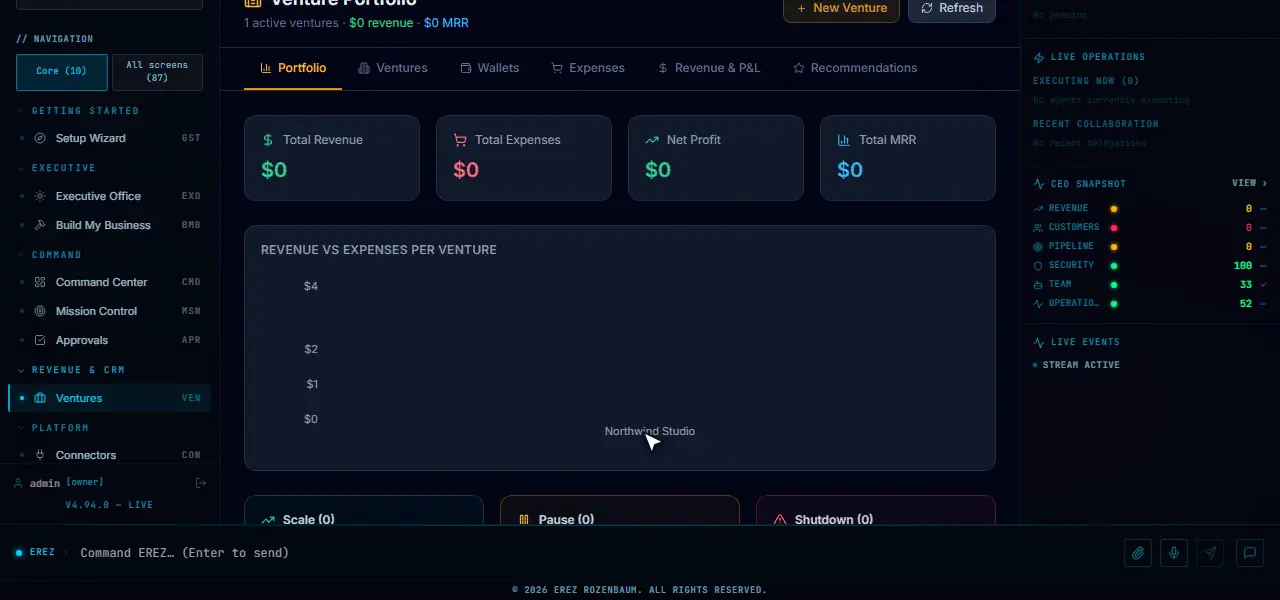
Founders and entrepreneurs
From an idea or a goal to a running company.
Start with what you want to achieve, not with a stack of tools. ErezAgent carries the goal through strategy, venture setup, build and launch, and keeps you as the approver.
- 01Shape the goalState the outcome. The goal brief gets a metric, target, timeframe and scope before anything is created.
- 02Let the Board challenge itExecutive roles deliberate, disagree, and list the evidence still missing and the assumptions to test.
- 03Create the ventureA new venture goes through Approvals and gets its own foundation: mission, target market and business model.
- 04Build and launchThe Launch Orchestrator coordinates brand, scaffold, deployment, DNS, payments, email and analytics; you choose where it runs (local, Vercel, Railway, Fly.io or Hetzner).
- 05Sell and measureGTM motions, offers and experiments link to real pipeline and revenue, so the objective shows progress against its metric.
Small and mid-sized businesses
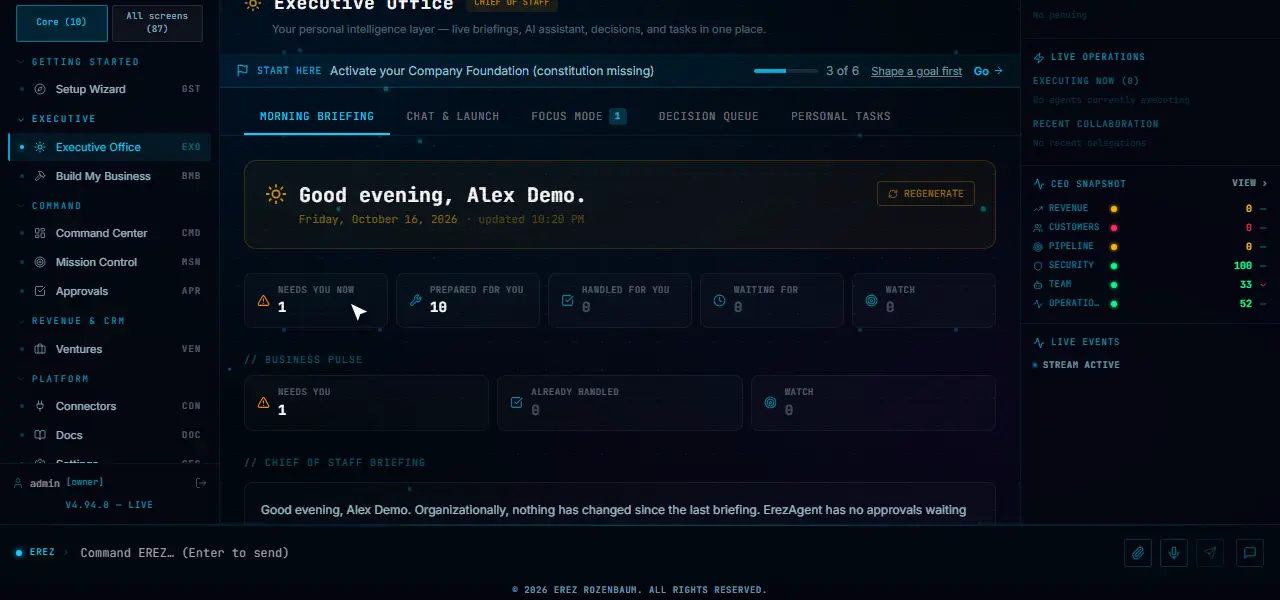
Run the business you already have, with a record.
Your business already works in a certain way. Business Twin learns it from your own material, and the platform is configured to match only after you approve.
- 01Set the foundationCompany Foundation gives every agent and Board deliberation your identity, principles and current priority.
- 02Build My BusinessUpload documents or describe the business. Every proposed process, role, record type and rule carries an evidence state.
- 03Approve the change setRecord types, document checklists, rules, workflows, customer portal pages and staff roles are applied step by step and read back.
- 04Operate with staff and customersStaff get focused workspaces and My Work; customers get a portal with stage progress, documents, forms, signatures and appointments.
- 05Know what needs attentionCustomer health, risk and findings show which customers need action today, and follow-ups stay human-approved.
Agencies
Deliver client work through one governed pipeline.
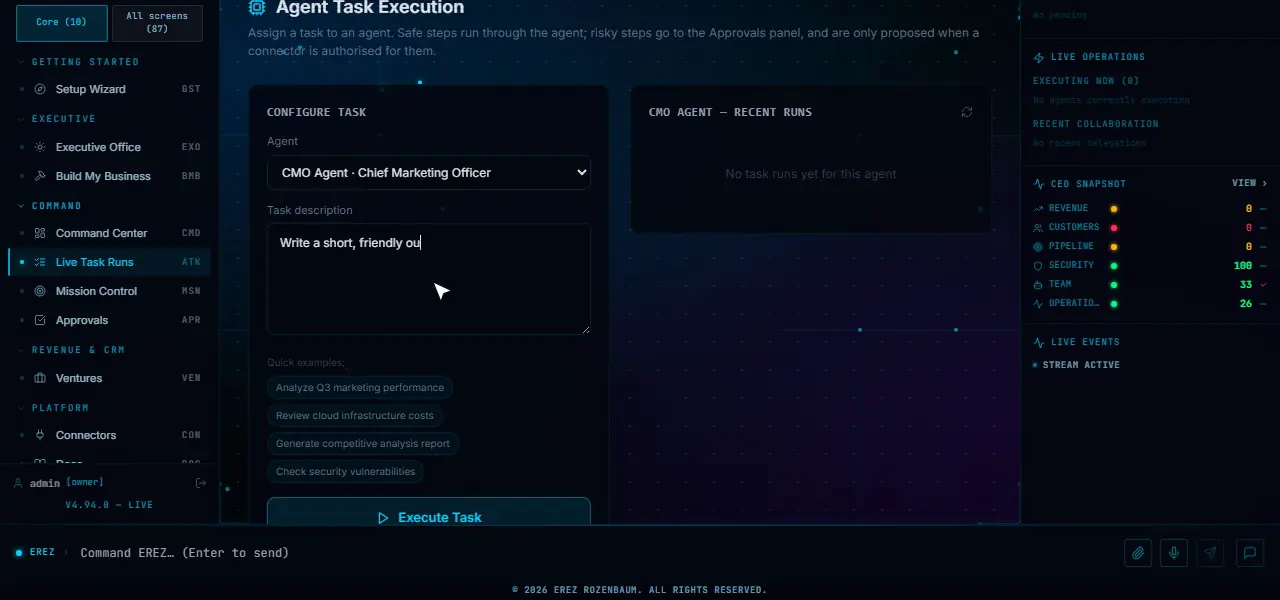
Client requirements become a traceable blueprint, delivery work, verification evidence and formal acceptance. The same governance model covers every client.
- 01Capture requirementsRequirement documents stay traceable to their source, with assumptions and gaps detected.
- 02Blueprint before codeEach requirement is classified as existing functionality, configuration, template, extension or custom software, to avoid writing code a platform capability already covers.
- 03DeliverArchitecture, engineering, design, testing, security and deployment run as governed project work with budgets and audit.
- 04Prove and acceptEvidence is attached per requirement. Formal acceptance needs passing evidence and a security check, or an explicit, recorded owner waiver.
- 05Brand per clientEach client can have its own customer-facing AI persona and portal branding, and its own usage statements.
MSPs, cloud and service providers
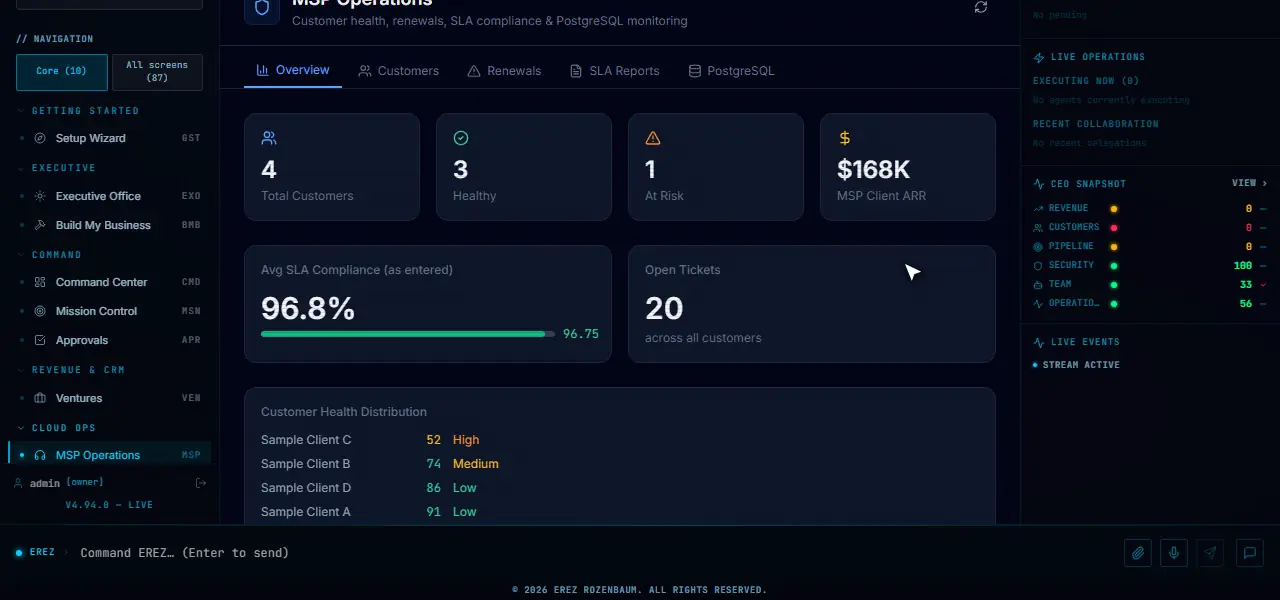
Dedicated deployments per client, one operating model.
Run ErezAgent for many clients without giving up isolation. Licences, billing and fleet status are built in, and every client keeps control of its own installation.
- 01Choose the modelOne installation per client (own database, Redis, keys and containers), or a shared installation with tenants isolated by row-level security.
- 02License downstreamThe Provider Console issues signed licences for the self-hosted installations you manage, with renewals and licence updates.
- 03Bill your clientsUsage ledger, statements, invoice drafts and payment records per client; usage from self-hosted installations is exported by the client and imported by you.
- 04See the fleet, with consentEnrolled installations report signed status. Filter for offline, unhealthy, update available, security attention or licence expiring, and send notices.
- 05Staff it properlyProvider staff roles (operations, support, security, billing, auditor) see only the Fleet page and only the clients you assign.
Next step
ErezAgent runs the work. You stay in charge.
See it run on a goal of yours, apply for early access, or talk to us about delivering it to your own clients.
Paid evaluation and guided deployment: talk to us. See the plans.